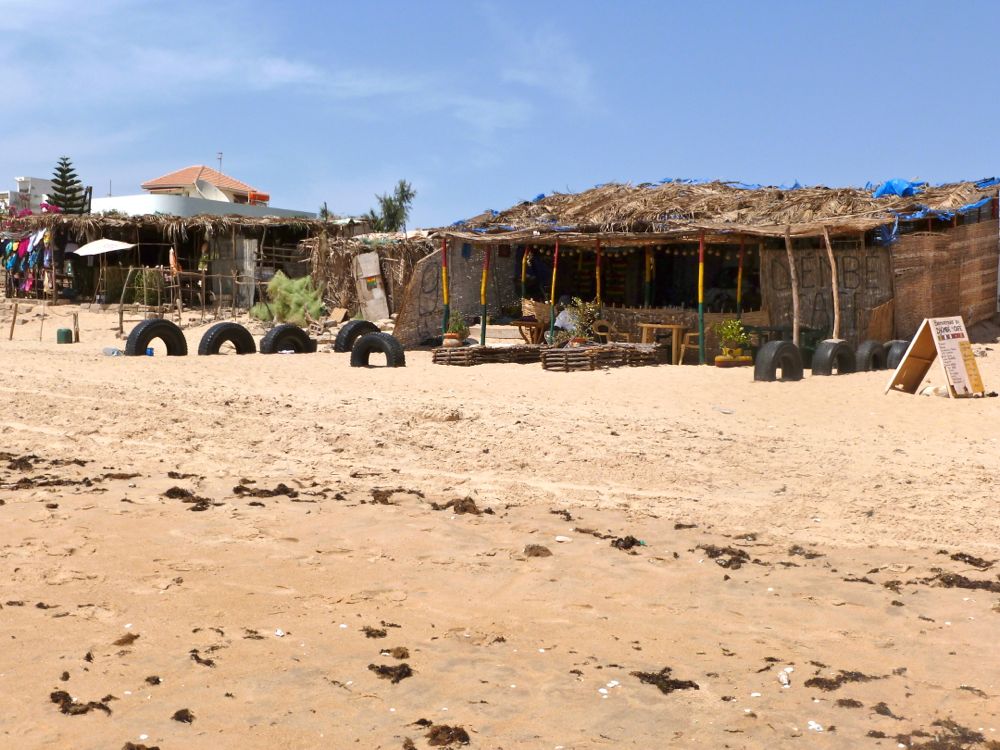
Saturday, June 8, 2013

Choosing Chance


Living with poverty every day here in southern Senegal makes me wonder about chances. The chance of being assigned to Senegal of all the countries in the world for Peace Corps service. The chance of me, one person, having an impact. The chances so many kids here don’t have to pursue their dream in life. The chance of being born in the US, one of the few countries in the world with so many resources.

It’s strange to think about – like thinking about how tiny we are, one tiny planet with life (that we know of) amidst all the fathoms of stars in space. (Yes, I did some stargazing and pondering in Mbour, my training site, while lying on top of the family well. At first my host sisters thought it was hilarious – what odd thing is our toubab doing now? – but eventually they joined me.)

As I pass my days here, where simple tasks like bathing take twice as long because we have to draw water from the well, my mind is constantly flitting between continents. I try to wrap my mind around the differences, like the fact that Americans have so many systems and services already in place that we don't even think about some of the fundamentals of living on this earth.

Childhood vaccinations and regular boosters make it unnecessary for us to worry about most life-threatening diseases. Doctors and health insurance take care of pregnant mothers and babies, but would we know how to keep them healthy without access to those services? Every kind of food or meal we could want is readily available from stores or restaurants, limiting our knowledge of how to actually cultivate the earth and scrape together natural resources into nutritious meals. Machines do everything for us: wash our clothes, wash our dishes, make our food, make our coffee. English is everywhere, spreading across the globe. But what if, as is the case for many Senegalese ethnic groups here, your native language was only a spoken one, and you had to learn another language to read and write? You might be smart in school, but a barrier now impedes your ability to succeed.


A toss of the dice and I could have been born in a village without electricity, where the nearest health post is miles away, speaking a language no one beyond West Africa knows, where the highlight of the day is drinking tea. But now I'm here regardless of where I was born, and I’d like to insert a small piece of wisdom from one of my best friends, Dave Spencer:

“Maybe you don't have all your modern conveniences, but it's all relative. Sometimes I think about that. If the highlight of their day is drinking tea, how ‘high’ is that highlight relative to our highlights? When we drink tea, it's nothing. So that means that they’re getting more enjoyment out of the simple things. Does the fact that we have more things make our society better? I'd say probably not. Does it make us happier? Definitely not.”

He’s right about the tea. After a few months in Senegal, I’ve started to appreciate the small things in life much more. The tinge of mint added to the tea. Wind, lifting the heavy heat. A cold drink. Silence – so rare here. Human touch (Senegalese aren’t big on hugs). The very few, blissful times I get to be fully immersed in water. The value placed on human relationships, on visits and greetings and knowing names.

Here in the Kolda region, it takes extra work to not only live but thrive – convincing mothers to take their babies in for vaccinations, making suggestions on nutrition, encouraging people to sleep under mosquito nets to reduce malaria. Without all the Western conveniences, life is harder, but it feels good when you know you can get by.

I may have been born in the U.S., one in 300 million, but somehow my path led me here to Senegal. Now I’m one of about 40-60,000 in the city of Kolda. Who knows what impact my tiny self can have? But there’s one thing I know for sure: I’m going to make myself more than a number.


Wednesday, May 1, 2013

Sewin' in Sambalaobe


With the rainy season in Senegal approaching, the threat of malaria looms like the storm clouds that will soon crowd the horizon.  Malaria is ever-present, a disease falling in bursts here and there upon the unlucky ones (often children under age five) snacked upon by a parasite-laden Anopheles mosquito.  But as the rains and floods come, leaving endless pools of stagnant water where mosquitos can breed – even in spaces as small as animal footprints on the road or leaves on the trees – the number of malaria cases will shoot up even higher.

According to a 2010 UNICEF report, 60% of Senegalese households owned at least one insecticide-treated net, but only 29% of children under age five were sleeping under these nets.  Fortunately, those stats have likely improved in recent years as Senegal has kicked off a “universal coverage” strategy to get every family sleeping under bed nets at night.  Partnering with the U.S. (through USAID, the CDC, Peace Corps) and nonprofits such as Malaria No More and World Vision, the Senegalese government has distributed millions of nets, to even the most remote villages.

As a result, cases of severe malaria have decreased, with some villages actually eliminating malaria deaths.  Combined with the greater availability of rapid malaria diagnostic tests and treatment, malaria is no longer the biggest child killer in Senegal.  But the country is still endemic, and the momentum needs be continued to keep the disease in check.

For us Peace Corps volunteers, the “Stomping Out Malaria” initiative is an important part of our work here in Senegal.  According to the ICPs (head nurses) I spoke with at health posts in Mbour and Kolda, malaria remains one of their biggest problems.  Families might own bed nets, but that doesn’t mean they sleep under them every night.  (I can attest from experience that enclosing yourself in a breeze-blocking net on 100°F nights takes a good bit of willpower.)

Kids with symptoms and fever are not always brought in for malaria tests, especially if the nearest health hut or health post is quite a distance away.  Expectant mothers do not always take IPTp (Intermittent Preventative Treatment for Pregnant ladies).  Health huts and health posts often run out of malaria treatment medication during the rainy season, when demand is highest.  There is still much research and advocacy to be done in Senegal.

For now, in honor of World Malaria Day on April 25, we worked with our Community-Based Training (CBT) host families to practice malaria net repair and care.  Unfortunately, it’s not as simple as sewing holes in nets: I have to master the vocabulary in French and Pulaar to talk about malaria as well.  Getting there, slowly slowly!


Thursday, April 25, 2013

And the mzungu transforms into a toubab… for now


After just over half a year, I have returned to Africa yet again – this time to the opposite coast! For the next two years, I will be living in Senegal, West Africa, as a U.S. Peace Corps Volunteer (PCV) in the health program. A primarily Muslim country once colonized by the French, Senegal is a strange and exotic blend of Islamic influence, African culture, and European structure.

School is taught in French, even though most Senegalese speak Wolof and other local languages better than French. While families typically serve traditional rice-based dishes like ceebu gen for lunch and dinner, breakfast is often baguettes and coffee – though in rural areas, poorer families may eat porridge instead.

The coasts are beautiful, the cities tumultuous and lively and dirty, trash lining the streets. Agriculture (especially peanut farming) dominates the Senegalese economy, and more than half of Senegal’s population of 13 million lives below the poverty line. Senegal ranked 154 out of 186 countries in the 2012 UNDP Human Development Index. Life expectancy here is about 60 years. Though the country has demonstrated great success in the fight against HIV/AIDS, Senegal is still endemic for malaria. The U.S. Peace Corps health program in Senegal addresses four main areas: malaria, child/maternal health, water and sanitation, and nutrition.

Here, I stand out even more than I did in Kenya, if you can judge this by the number of (either shrieked, giggled, or shouted) “toubab!” comments that follow me everywhere. In Kenya, the word for foreigner was “mzungu,” and it was called out often enough – but mostly by giggling kids, who threw big smiles my way as soon as I turned to look. Here, as our Peace Corps trainers have informed us, Senegalese of all ages (not just kids) like to point out differences. The word “toubab” here means pretty much what “mzungu” meant in Kenya, but it seems to be hurled around with slightly more intensity in Senegal. And it’s not always accompanied by a smile. It’s practically a mandatory identifier – I heard a mother whispering it to her toddler as she rattled by on a horse drawn cart, and I’ve even been hailed as “mademoiselle toubab” by a vendor on the streets.

Still, while the Senegalese seem a bit more blunt or aggressive than Kenyans in some ways, there is plenty to love about this culture. The more I learn, the more I love.

A few snapshots of my first few weeks in Senegal:

  • Occasional brain short-circuiting due to massive overload of health and tech training / safety and security sessions / language and culture classes / learning, learning, and more learning for Peace Corps
The Peace Corps training center in Senegal
  • Brilliant, hot, blazing sun – every single day during the dry season (now). While the heat can get intense, I’ll take this over snowy U.S. winters any day!

  • A constant film of dust or dirt or sand coating my skin…

  • …which gets washed away by chilly bucket baths when I’m in my village, and much appreciated showers when I’m at the Peace Corps training center in Thiès.

  • Cobbling together sentences in French/Pulaar/Wolof – basically, whatever gets me understood – and attempting to squash the random Swahili phrases (Kenya remnants) that keep popping in my head

  • Shuffling through sand in Mbour, a region near the beach, where houses seem plopped directly onto desert and little patches of dirt are imported to create mini gardens
      My host family's compound in Mbour, Senegal
    • Massive excitement on my part to be served salad and fresh vegetables, a rarity in village life, by my Mbour host family on my 25th birthday

    • Consuming endless rice and fish out of shared bowls – sitting on the floor, the traditional Senegalese way

    • Learning to eat and do almost everything with only the right hand to avoid offending anyone

    • Earning about $16 a week from Peace Corps and feeling rich when I get it – 8,000 CFA goes pretty far here if you’re living a simple life!

    • Continuously living out of a suitcase – this gets rough after a month and a half!

    • The constant, quavery, megaphone-enhanced singing that ripples through the air from mosques here, there, and everywhere. This chanting marks the calls to prayer throughout the day.

    • Floating in the turquoise ocean, so salty the buoyancy was like laying on a waterbed

    The beach at Mbour


    • Devouring chilled bouye (baobab fruit) or bissap juice whenever I can get it – or, on a less culturally explorative scale, orange Fanta – basically anything at all chilled! The best discovery so far: crème, an ice-cream like frozen juice concoction sold in little plastic baggies (sachets). You eat it by biting the corner of the sachet and sucking out the juice. Pure heaven in the heat of the day!

    • Learning not to go to the beach in Mbour on Sundays, when we’ll be surrounded by the a chaotic mass of Senegalese youth on their day off – who, if they happen to be young boys, will follow us to demand everything from a sip of water to a “cadeau” (gift), money, attention, love, or marriage

    • Getting excited when I actually squash a mosquito because it means my reflexes are improving and I just dodged possible malaria exposure yet again

    • Dancing under the piercing African stars to reggae music with my host family sisters, who wear the radios slung across their body like purses

    • Periodically walking long distances just to buy fruit (apples, clementines, bananas) – my favorite dietary supplement!

    • Shivering with cold when the temperature drops to the low 70s or 60s Fahrenheit in the mornings and evenings (days can get up to the high 90s in the Dakar/Thiès area)

    • Laying in bed at night, sweating under a mosquito net, wishing hard for sleep through the cacophony of above mentioned singing, roosters who enjoy periodically reminding us of the hour, cat fights (or wild dog v. pig fights), and distant drum circles.

    Me tucked in my mosquito net at night
    • Learning the importance of greetings as a sign of respect. There are a million varieties of greetings among Senegalese, depending on the language, time of day, and how well you know the person. A simple American “hey” doesn’t cut it here!

    • Drinking hot, sweet, minty ‘ataaya’ (Senegalese tea) from little glass cups even in the blazing heat of the day – it’s a mark of hospitality to be offered ataaya, so you shouldn’t refuse. The Senegalese have made tea into an art form: pouring it from one tiny cup to another, back and forth until the tea froths and foams. 

    My host brother in Mbour making ataaya (tea)

    And there you have it… first glimpses of Senegal, which you can hopefully collage together into a mental picture of my new home.

    Yes, sometimes I lay in bed at night under my mosquito net and wonder what the heck I’ve done committing to two years away from home. Two years of heat, bugs, long skirts, and pulling water from wells. But then I think of my wonderful Senegalese host family, this chance to soak up a new culture, all the huge strides in the domain of health that have been made here over the past few years, the momentum that must be kept going… and I find my motivation again.

    Tuesday, October 30, 2012

    Return to Children's Cancer Ward - Nairobi, Kenya

    This August-September 2012, I made my second trip to Africa. During my time in Nairobi, Kenya, I returned to the Children's Cancer Ward at Kenyatta National Hospital, where I was able to donate books and supplies using the money I had raised back in the U.S. To all those who contributed: thanks so much for your support!! You should have seen the big smiles of these kids. Check out the photos:

     Here I am with the group of kids!

    Don't know where they got these costumes from... but I highly approve


    Me with one of the kids

     This girl was too weak to play with the others. I sat with her and we did puzzles for a while. 


    I'm going to miss those kids - hope I get a chance to return next year!

    Thursday, January 12, 2012

    Why Go Abroad?

    Just four months ago, I stood scooping beans into canvas sacks in Kenya to hand out to hungry families. My skirt swept the dusty ground; my sandals were stained Kenyan-earth-red.

    Now, I stride around in blouses and heels and business attire - a chameleon shifting to match a strikingly different world: the U.S. government. Despite the change, dealing with U.S. Embassy projects has reinforced what I suspected already: an educated worldview, especially one gained by actually traveling to see the world, is priceless.

    What does it say about American society that we can Google Earth the far corners of the world in a second, but we tend to stick to our own neighborhoods and social circles - not to mention our own language? Only 30% of U.S. citizens have passports, according to a CNN report; even fewer are bilingual.

    Here’s why I go abroad, and why you should be part of that 30% - and the even smaller percentage that catch the travel bug for life:

    1. To understand what drives cultural practices – why human beings, ourselves and others, live the way we do.

    2. To see yourself through the eyes of the rest of the world, gaining perspective on your own culture.

    3. To discover beauty in all its facets and faces.

    4. To draw inspiration from the artistic expressions of other cultures. Human capacity for art and creativity is endless.

    5. To enrich your life with friendships stretching all across the globe. (Not to mention that from a networking perspective, it never hurts to have contacts in many different countries.)

    6. To contribute meaningfully to today’s global society. Many of my friends in Kenya are a click away on Facebook, so it seems easy to say we’re linked to the rest of the world. But after seeing the struggles of many Kenyans trapped in poverty (starvation, AIDS, malaria, stigmatization of disabilities, etc.) with my own eyes, I can now better explain and advocate for help from Americans at home. I have proof – photographs, quotes I wrote down, people I can call on as sources. I can also better interpret and analyze our own media: what stories are told and what is left out; whether political spin is slanting world stories and reports; what is considered important “news” elsewhere in the world versus here in America.

    7. To collect stories to tell. As a result of my many trips abroad, I never run out – whether it’s getting washed down a waterfall in Australia, building a house out of mud in Kenya, or losing myself in the streets of Rome for a day.

    8. To shatter stereotypes – either those you’ve unconsciously held against others, or those others have assumed of you. For me, I want to prove not all Americans are insensitive, uncultured, self-absorbed, rich, bland. The truth is: we have our failings as a society, but we are diverse, ungroupable; a collection of differences. We come from everywhere, our skins shaded every color. Some of us don’t care about the world – but many of us do. Just the other week, my Congolese friend told me something that I’ll never forget. We were discussing world problems – the turmoil of Arab Spring, the villages I visited in Kenya struggling to survive without food, business monopolies keeping down the poorest of the poor, and the filmy coat of corruption greasing much of U.S. politics. He argued that changing the way we run elections in the U.S .(such as banning private endorsements to candidates) could go a long way towards changing how things are run in the country as a whole – i.e. many of the issues scrawled across the posters of “Occupy” protestors – and could even change the world. “I think Americans are actually good people,” he said. “I think regular Americans are like you – trying to help people, traveling to other countries, hoping to make a difference. But those are not the Americans that get elected.” Those are not the Americans that the world sees. But we can change that.

    From every trip I return with new ideas, new inspiration, and new friendships. Immersion in the world is just as valuable an education as the one you gain in college.

    Next trip for me? Maybe a program through GoAbroad for improving French and volunteering in Cameroon; or maybe I’ll return to Kenya to work with HEART once again. The opportunities are endless, if you take the time to look.