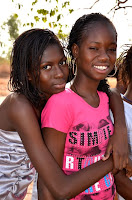
Take a look at this photo taken during our Bagdaji Youth Empowerment Camp last week. What do you see?
Besides some crazy expressions (including mine)... what I see is a sea of smiles. Really, look carefully: not a single kid in this photo looks bored or irritated, like we’d expect from at least some kids in a group of teenagers. Instead, I see laughter, intelligence, mischievous glints in dark eyes, and pride at being selected for the camp.
This was the second youth camp I’ve participated in during my Peace Corps service - the first one was an English Camp in Dakar (not an overnight camp). This one was even more fun.
What does Youth Empowerment Camp look like in Senegal? A little bit of everything! We mixed art and sports and fun with important life lessons, exposing the kids to things they’d never yet had a chance to experience. Tie dye, dodge ball, tag, intro to karate and self defense, theatre skits, discussions on health issues and gender equality, a career panel and life planning sessions, art, a game teaching money management, movie/popcorn night, spontaneous dancing to Beyoncé, and more.
 |
| Karate session |
 |
| Nutrition activity |
 |
| Musical chairs (with human chairs!) |
 |
| Tie-dyed shirts |
In general, the camp aimed to equip these kids with the knowledge to live healthy lives, express themselves, and pursue their dreams. 12 girls and 12 boys, the best and brightest of middle schools throughout the Kolda region of Senegal, were invited to the four-day camp. Some were from the city, some from small towns, some from villages. Over half of these students had no electricity at home. It was a big mixing of worlds.
Happily, all 24 showed up, enthusiastic but unsure what to expect. There aren’t many camps for youth in Senegal, so many people here don’t actually know what a “camp” is. (And I’ll tell you, it’s pretty amusing trying to explain the concept in Pulaar…)
Once we got to know them, it was clear that these were really some of the most awesome kids we’d ever meet. They were extremely smart. Most spoke at least two languages (Pulaar and French), and some spoke three or four (Wolof, English). Throughout the four days of camp, they participated eagerly in every activity. They soaked up the knowledge that we and our Senegalese partners showered on them, asking questions and taking notes. One kid - a tall 16-year-old always dressed like he just stepped out of a men’s magazine - couldn’t be torn away from his notebook. It was funny, but great at the same time: apparently you can take notes and still be fly.

In fact, a lot of these kids dressed pretty fancy. With the heat in the upper 90s (Fahrenheit), it’s normal here to bathe 2 or even 3 times a day - but some of these little fashionistas actually changed clothes each time, revealing 2 or 3 new outfits in one day! Considering they all arrived with one small little backpack or sack while we volunteers lugged large duffels, we still don’t understand it. Magic bags??
Bringing the Camp to Life
For an event of this size, you need a lot of help. (Just to give you an idea, this project took about 6 months to organize and required a decent sized grant!) Two Peace Corps Volunteers (PCVs), Alexia Kime and Sophie Danner, were the camp leaders in logistics and planning - but the camp was really the collaborative effort of many. A local NGO, Ofad Nafoore, hosted us during the camp. Senegalese partners (nurses, teachers, local professionals) were also invited to help out with various activities. About 13 PCVs participated in the camp, each of us taking on different sessions.
I helped organize the art session, teaching the kids how to make animal dot paintings loosely based on the concept of Aboriginal dot painting. (Thank my trip to Australia for the idea… yes, Aus is still on the brain.) But the kids loved it, and while some chose to copy our samples, others took plenty of creative liberty. Check out my little artists:
I also helped out with the session on First Aid, along with a few other PCVs and a local health worker who brought her medical kit to show the kids. We taught them what to do for heat exhaustion, burns, cuts and other injuries, and choking. The Heimlich maneuver was probably the biggest hit of that session. One group of kids even surprised us (and cracked us up) by including it in their theatre skit later:
 |
| Heimlich during their theatre skit |
 |
| First Aid session |
In addition, two community health workers came to talk to the kids about sexual and reproductive health - everything from puberty to STIs and HIV. We split into two groups, girls and boys, so they’d feel more comfortable to have a discussion. Many of them already knew a lot, but some didn’t. The girls asked a lot of questions, including: can you play sports while it’s your time of month? What can you do about the pain (cramps)? Happily, all of the girls agreed that their monthly cycle shouldn’t prevent girls from going to school. Traditional views used to keep many girls home for an entire week each month, but thankfully that’s not often the case any more.
 |
| Reproductive health talk |
One of the best sessions during the camp was a discussion led by Peace Corps employee Mama Awa Traore, our beautiful, regal Senegalese guru. This woman is amazing - you can tell just by looking at her in photos. She knows how to command an audience to rapt attention - and how to get us laughing.
 |
| Mama Awa Traore |
This time Awa talked about sexual equality with the kids, asking questions to see what they already knew about topics like early marriage and school dropouts, gender roles, and other sensitive subjects. She handled every topic bluntly, but gracefully. She assured them that it’s normal to have boyfriends and girlfriends at that age, but they have to be smart about the choices they make.
“They say that girls in Kolda are beautiful, but easy,” she said to the kids. “Why?”
Responses on why early pregnancies were so common in Kolda centered on the reality of poverty. Lack of money means girls might jump at the chance to have a man give them money or clothes, or the girl’s own mother might even prostitute her daughter for money (this is rare but does happen, sadly - one of the girls in the camp had seen it herself). Teachers have been known to get their own students pregnant. It’s a vicious cycle.
Awa wanted the kids to know that there is a way to break that cycle, and that is through respecting yourself, having life goals, and pursuing an education. “Do you know your own mind? Do you know who you are? Do you know what you want?” she asked them. “You have to know and respect yourself. Only education can get you out of poverty. It’s not the 1,000 or 2,000 francs someone gives you, it’s not the clothes someone gives you.”
She also encouraged the kids to expand their horizons on roles for men and women. “A woman can fly a plane, a woman can be an electrician, can build a house,” she told them. Anything is possible.
One of the other most inspiring sessions of the camp was the Career Panel. We had invited several Senegalese professionals in various careers to come and speak a little to the students and answer questions, discussing their own experiences and how to achieve success in life. Speakers included two nurses (female), a community organizer for Child Fund (female), an information technician (male), a social relations manager for a construction company (female), an agronomic engineer from World Vision (male), and two teachers (male/female).
Career Panelists' Advice / Experiences:
“Be proud of what you are.”
—Sali Baldé, Ofad Nafoore
“If you wake up in the morning and you have no destination, will you end up somewhere? He who manages his time well is he who succeeds.”
—Luc Manga, World Vision
“Accepting that you’re a student means accepting that you have a teacher, even if you don’t like him.”
—Mamadou Diao, Information Technician
“All my girlfriends were married at a young age, but happily my father refused. He encouraged me to study.”
—Aissatou Diallo, community organizer for Child Fund's maternal and child health program
“There’s one teacher I will never forget. He would even come visit me at home, and if he’d find me in the middle of cooking dinner, he’d say, ‘No, this girl shouldn’t be cooking, she has to study.’”
—Mama Camara, nurse
 |
| Interviews conducted by students during Career Panel |
 |
| Career panel |
Following the career panel, we had another session on future planning to encourage the kids to follow their dreams and set concrete goals to get there (e.g. finish high school and pass the Baccalaureate, get a scholarship, go to university or trade school, do internships, etc.). We also had the kids draw what they envisioned as their future (dreams/goals/interests). ...And yes, I drew one too!
 |
| My self-portrait (travel, journalism, writing/photography) |
Among the kids we had a range of career interests, from doctors to teachers, journalists (woohoo), and three future Presidents of Senegal (two girls and one boy)! Mamadiang Diallo made sure we knew that when he became President, his ministry would contain large numbers of Diallos and other important family groups (last name jokes are a big thing here).
 |
| Mariama Diallo wants to become an eye doctor / ophthalmologist. |
By the end of the camp, the kids were all thick as thieves and had all exchanged phone numbers, just like any summer camp in the States! At our closing ceremony with the kids and their parents, we learned that many of their parents hadn’t actually finished school themselves, and they regretted it the rest of their lives. They told us they were extremely proud of their children for doing so well in school and being selected for this camp.
“Everything we are doing here is to support you, but the most important thing is to say, ‘We can do it,’ and push until you do it,” our PC Volunteer Support Assistant Tidiane Diao told the parents and students in the audience. “To be educated is to know how to better handle things, how to better take care of your life, how to better help people to achieve their goals.”
Of course, education comes in all forms - not just what you learn at a desk in school. We’re hoping this camp gave these kids some of the tools they need to succeed both in the classroom and beyond. Also, if one of these kids ever becomes President of Senegal… we got the hook up!
 |
| Tidiane Diao giving his speech |
 |
| Camp housing |
 |
| Gender equality: boys can serve the food too!! |
 |
| Me with my group of kids from the city of Kolda |
 |
| Me (camp photographer!) and my PCV friend Tasha (camp dance queen!) |