Showing posts with label development. Show all posts

Friday, December 12, 2014

How to React to Talibés: 7 Tips for Peace Corps Volunteers

Talibé children in Senegal and the flood of issues connected to them – from health to human rights and child protection – have become my world for the past year and a half. I almost can’t even remember what it was like to first arrive in country and see these scruffy kids everywhere with their begging bowls. It’s hard to remember how much research I had to do and how many visits I had to make to daaras* in Kolda before the complexities of the talibé system really sunk in. And there’s always more to learn.

From the beginning, I felt that many talibés were being exploited, forced to beg for change on the streets to “support” their marabout (Quranic teacher) and his daara. I didn’t understand why a society could allow this, though. And I didn’t know if this was a facet of the culture I was supposed to respectfully ignore – or if many Senegalese actually felt the way I felt.

I can now answer that question: yes, many do feel the same way. But “Africans don’t have the culture of denunciation,” a radio journalist in Kolda explained to me once. Layers of tradition, respect for religious leaders, and poverty have prevented most people from speaking out for many years. That is changing now, little by little.

The hardest part for me now is to remember how I used to feel about talibés, these sometimes sweet and sometimes abrasive, world-weary boys roaming the streets. But when I read back through my old journals, I remember: I was intimidated, overwhelmed and a little frustrated. I didn’t know what to think about these kids because I didn’t understand the whole system – but they wouldn’t leave me alone, and they were making my transition into this new culture even harder.

It wasn’t until I sat through a presentation by former PCV (and talibé guru) Hadiel Mohamed a few months into my service in early 2013, and then followed up by pestering her with a million questions, that I understood how to look at the issue and how to keep my compassion front and center when dealing with them. Now by working with SeneGAD**, I’m hoping to pass that perspective on to as many people as possible, because honestly: it doesn’t come naturally. I still have to work at it every day.

Abrasive or confrontational kids getting up in your space will inspire negative feelings or reactions if you don’t train yourself. And that’s okay – you just have to recognize why you’re feeling these things and know what to do.

So how do you train yourself to look at talibé kid with a different mentality? How should we react?


Here are 7 tips on how to act around talibés:

1.  Remind yourself, when you see them, that these kids have had an extremely hard childhood. They’ve been treated differently from other kids and exploited – sometimes abused – since age 4 or 5. They are children forced into the role of adults, finding food and caring for themselves. They are often uneducated and their future might look pretty bleak. Whatever attitude they project at you is a defense mechanism they’ve learned to survive a very harsh life.

2.  If you feel angry or annoyed at what these boys say or do to you, try to redirect your anger towards the system and the adults who have put them into this life and made them act this way. Use that anger as fuel towards building projects that can help. It’s not the fault of the children.

3.  The best response to a talibé’s demand for money is to greet him. Remind him that you’re a person, he’s a person. Shake his hand, ask his name and where he’s from.

4.  If a talibé keeps asking for money and you don’t want to give, here are some things you can say: “Sorry, I don’t have change.” Or “Next time, inshallah!” If you want to make a joke out of it, you can add something like, “Sorry man, I’m really not ‘noosing’ these days… Times are rough!” (Noos is a Wolof and Pulaar expression meaning having fun and having money.) Phrasing things this way won’t harm anyone and will make talibé feel acknowledged. Simply saying “no” without explanation is not how the culture works here. These kids won’t understand your deeper motivations behind this – they’ll just assume you are stingy, rude, or don’t care about them.

5.  See a big pack of talibés coming your way? This used to intimidate me and I’d try to avoid it, but now I try to look at is as another chance to remind them that we don’t think they’re invisible or distasteful. Give them a smile and a greeting, or at least a wave and eye contact, as you walk through. You don’t have to stop and be surrounded – that acknowledgement is enough.

6.  If a talibé insults you or makes a joke at your expense, either ignore it or make a joke back. Getting angry will not result in behavior change.

7.  Give something (not money) once in a while! There are countless debates over whether it’s an act of compassion or simply “fuels a bad system” to give to talibés. After all this time working with them, I’ve decided that giving money should be avoided, since it often goes back to the marabout and does perpetuate the system. However, it’s good to give the kids other small things every now and then – fruit or other nutritious food, soap, sandals, etc. It can help them meet an immediate need, can make them happy for a little while, and can incline them to trust and like you.

Most importantly, remember these are at-risk kids, generally far away from their families and often lacking a mentor to guide them through life. Some marabouts fill that role, but others do not, teaching them to memorize the Quran and little else. Who knows what kind of impact you can have if you try?


*Daaras = schools where talibés live and study the Quran under tutelage of a marabout

**SeneGAD = Senegal’s Gender and Development group for Peace Corps Volunteers, focused on gender equality and youth empowerment

Sunday, November 9, 2014

City or Village Life: Which Would You Choose?

While there are definitely stereotypes associated with Peace Corps - some people imagine a hippie life on an island, or a hut deep in the jungle - the truth is that PCVs can end up in all kinds of different living situations around the world. You'll find us living in huts, houses, apartments, you name it. You can end up way out in the bush, five minutes from the beach, tucked away in a small town, or lost in a bustling metropolis. 

I can't say I wish I had been one of those Peace Corps Volunteers placed in a village. I’m happy being a small city volunteer in Kolda, Senegal, because it satisfies my inner drive to always be on the go. I can never be bored here, at least in a work sense! 

There are hundreds of people and dozens of organizations I could work with, which means endless project possibilities. I can work with talibés one day, then nutrition and moringa, than switch it up to a youth internship program - and I love that variety. Also, French is more useful in a city, where it is used in professional contexts. (Every-day conversations are usually conducted in local languages like Pulaar). I’ve loved being able to work in two languages.

My house! And my little host brother, Omar "Doctor" Baldé.
The well inside my family compound
Me with Double Horizon, a local youth group I work with sometimes.
Some health relays I work with in Kolda (we were doing door-to-door vaccinations for children)

Despite the perks, city life isn't all that golden. Unfortunately, Peace Corps Senegal doesn’t equip health volunteers as well for serving in cities. We come in expecting to live in remote villages, and that’s how we are trained and prepared. We learn about baby weighings, how to make nutritional porridges, how to implement well or latrine-building projects – all things relevant in villages, but less so in cities. Then, suddenly, a very few volunteers “luck out” (depends on your point of view) and get placed in small cities or road towns.

Sure, we get electricity and easier access to Internet. The downside is we have to pave our own way and navigate an overwhelming sea of people, trying to find our niche and be relevant and useful, with less guidance from Peace Corps. Big towns already have qualified Senegalese personnel running health and development projects. Duplicating their efforts is not a sustainable contribution. Reinforcing capacity is nice once in a while (like helping local health workers with their child vaccination campaigns), but it still doesn’t make a lasting impact.

Instead, it’s best to find your little niches – meeting the needs that are not already being met, or offer a unique approach to something. A few months into my service I finally started finding those niches, but it took a lot of research and questions to get there. If you're not careful, you can get lost in the city, swallowed up by existing projects and feeling like a needle in a haystack.

When I call Kolda a “city,” I should clarify: Kolda is nothing like Dakar, the capital, which teems over 1 million people living in both luxury and poverty. In Dakar, you can find smoothly paved streets, nightclubs, high-end restaurants (even sushi!), beautiful beaches, a modern shopping mall (where they are currently building a movie theatre), a giant stadium for Senegal’s soccer fan multitudes, art galleries, fashion shows, cafés, and air-conditioned stores with all kinds of imported products. We call these “toubab stores,” because really, only toubabs (foreigners) go there. Most Senegalese won’t be dropping 5,000 CFA ($10) for real ranch dressing or a box of Pop Tarts.

But in Dakar you will also find intense poverty, dusty dirt roads, trash on the streets, sheep and other animals roaming everywhere, open-air markets, donkeys pulling carts next to the sleekest cars, millions of small boutiques, and ragged talibé boys roaming the streets with their begging bowls.

Dakar 

Compared to big cities like Dakar and Thiès, Kolda is definitely more of a very small town. We have a few gas stations that offer products geared towards toubabs – shampoo, Nutella, Pringles, cereal – but not much. We are one of the southernmost regions in this country. You know you’re nearly the furthest you can get when there’s no ice cream to be found! In fact, many people don’t even know what it is, sadly. Though we have refrigerators and convenience stores, there’s no way to transport ice cream all the way down here without it melting.

The majority of Kolda’s population lives on the outskirts, not downtown, and many do not have electricity. Most people live in huts, or combinations of buildings and huts, arranged in a square or circle. This forms a family compound. In the middle of the compound is dirt ground, but they treat it like a floor, sweeping it smooth of debris and animal droppings. Most families also keep animals in the middle of their compound – usually goats, sheep, chickens, and cows. In the city, you may witness the weird dichotomy of a giant satellite dish next to a reclining cow or a bunch of sheep. (Welcome to my house!)

Just like anywhere in Senegal, whether village or city, you’ll find families in Kolda relaxing and socializing in front of their houses, drinking tea. Unfortunately, Jakarta taxi motorcycles buzz like flies – roar like lions would be more accurate – everywhere you go. True silence is rare. After a while, I realized I needed a break from it all.

My family compound, sheep, satellite and all.
Mix of buildings and huts in the city of Kolda
You still find random things like this in a Senegalese city... donkey carting soft drinks to a bar.
Kolda city school kids - - there's a LOT of them.
Inside another city house (Kolda).

Village Visit

Recently, a PCV friend of mine had been encouraging me to visit his village before he finished his service, and I finally found the time to do it. I’m so glad I did. It was just what I needed!

A small village just outside of the big city of Tambacounda (a 5 hour drive from Kolda), Botou breathes calmness in the way that cities never can, unless you’re on the coast and can chill ocean-side. It had been too long since I’d visited a village – I’d started to forget how peaceful and relaxing it can be out there.

In village, without realizing it, you fall into a slower rhythm. People take their time. What do they have to hurry to? I found myself sitting for hours, just talking, without getting antsy like I normally would. It was a miracle!

The beauty around me probably helped: clean air free of car exhaust and the growl of motorcycles, green and trees everywhere, rich gardens of tomatoes and cassava and hibiscus, fields of peanuts and corn and millet. The bush stretched out behind us in an endless expanse of scruffy grass and spindly trees, pierced here and there by massive baobab trees.

At night in village, no light other than cooking fires or flashlights illuminates the deep dark. The inky blackness settles over everything with finality. As a result, you start waking up earlier and going to bed earlier. Without electricity, food is never saved. They buy ingredients daily, cook and consume. Ice and cold things become a distant memory.

My friend’s hut was everything mine isn’t: small, square, clean, organized and rustically lovely. (I inherited some unfortunate situations with my hut that I won’t go into.) His window looked out at some refreshing green, shaded by a large neem tree. He had built himself a front patio out of wooden branches, perfect for relaxing out of the sun. Behind his hut, he’d set up a garden and a gym training area. (Yes, you can stay in shape even out in the middle of nowhere, if you get creative! Think rice sack punching bags, stone-stick-rope contraptions for weight lifting, etc.)

One of the things that I love most about village life is its quietness. Instead of car sounds and all the other noises of the city, I heard the wind in the trees, crickets, and the occasional animals. At night, wrapped in that refreshing silence, I fell asleep so much more easily.

Village Botou
Some bitter tomatoes in Botou 
Village kids in Botou 
You will also find random things like this in villages! (No electricity, but a phone booth.)
My friend's hut

Villages have their downsides too: more extreme poverty in some cases, less diet variety, a lower level of education, less to do, nothing cold to refresh you from the heat, no electricity to charge electronics, lack of medical services (the nearest health hut or post may be kilometers away). PCV friends of mine sometimes groan about the slowness of village life. Implementing projects, and really doing anything at all, will take a lot longer. People may or may not be interested in working with you. If a village of 200 people has only 10 or so interested in working on a project, your options become pretty limited. Of course, every site is different.

Still, many volunteers love village life for its simplicity, friendliness, and natural beauty. It's true, I miss being surrounded by nature. Slow and calm is nice, sometimes, but I don’t think I’d want that every day. All in all I’m happy where I am.

But there is something special about village life that I think everyone should experience at some point in life, if you can.

Whether it’s a village somewhere in Africa or Asia or South America, if you ever get the chance, go. Spend a night or two. You’ll find that your world shrinks, concentrates, intensifies into the moment. The calm seeps into you. You see dozens of people getting along just fine without things you thought you needed. Taking the time to greet and connect with people becomes so much more important, because it’s the human relationships that maintain such a community. There's a lot to learn from this way of life.

Wednesday, September 24, 2014

The Miracle Tree: Article published in The Culture-ist!

Attention all nature-lovers, humanitarians, gardeners, or organic food aficionados: ever heard of Moringa, the "Miracle Tree"? Curious how one little plant can make a huge difference for nutrition and community development in tropical countries around the world?

Check out my latest article / photo essay published with The Culture-ist, an online travel magazine, to learn more (and to see photos from one of my biggest projects here in Senegal)!


Tuesday, March 18, 2014

Fairly Crazy

Through a combination of enthusiasm, sweat, and creativity of necessity (and maybe a few tears and hysterical laughs), a team of four people including myself managed to pull together this year’s Kolda Regional Fair. I have never planned and coordinated an event of this size before. It was a massive undertaking, from the planning and budgeting to the weekend of the 3-day event itself. Countless things went wrong (pretty much inevitable with projects here), but somehow it all came together! I can tell this event means a lot to the community, so even though we all went a little crazy making it happen… I’m happy we did it.

Despite the fact that Kolda is one of the most fertile and agriculturally rich regions of Senegal, the poverty and malnutrition rates here are some of the highest in the country. To help combat this and show off the true potential of this region, the Kolda Agricultural Fair has been an annual event since 2011 – an ongoing collaboration between PCVs and local partners. The Fair promotes the development of the Kolda region by providing an opportunity for artisans, entrepreneurs, agricultural producers, NGOs, financial institutions, and small business owners to get together and share best practices, demonstrate new techniques and technologies, promote and sell their products, and have discussions about community development issues.

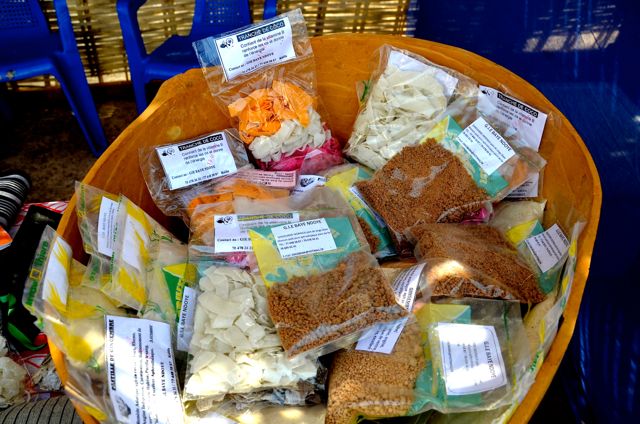
This year, an estimated 400+ members of the public attended the Fair over the course of the 3 days. 43 participating groups (over 140 individuals total) had stands in the Fair, displaying their products and offering demonstrations. Products and technologies on display included: solar pumps, moringa powder, packets of dried mangos (yum), mango jam, moringa soap, fonio (a kind of grain), beans, rice, shea butter (known as “karite” here), curd (called “kossam” – sour milk frozen into a yogurt-like treat), hibiscus (“bissap”) juice and tea leaves, fruits and vegetables, beautifully embroidered clothing, batik, artwork, herbs, baobab fruit powder, cashews, tomato paste, juices and syrups, cheese, and more.

Packets of local herbs
Batik clothing. I love the elephants!

Astou Mballo, tailor (Endam Couture), and her beautiful clothes!
Local produce
Ma Baldé and her women's group selling honey!

Baobab fruit, bissap (hibiscus), and more ground into powder form. Just add water, and presto: you have tea/juice!

Solar water pump
Locally made jams. Banana, Papaya, Mango... yum. 

I had to run around like a madwoman most of the time making sure everything was going smoothly, but when I had some time to browse the stands, I found some exciting stuff. In particular, I fell under the spell of everything mango – mango jam, dried mango. Kolda produces so many mangos each season, but so many of them go to waste due to poor transportation and export systems. You find yourself craving them months before they’re ripe, especially in this heat. Now I could taste mango before the season even arrived! Score.

Fair co-coordinator Mountaga Baldé with a bag of dried mangos 
Me with Mountaga, trying to get things organized!

Another reason to be happy: we had expanded the Fair this year beyond agriculture and into health (I am a Health PCV after all!) and the arts (throwing a youth talent show). In the health domain, we had free HIV testing and booths / discussions on family planning.

The booth raising awareness on Family Planning

The talent show was held in three parts each night of the Fair, with four middle school groups and one youth association competing. We had a dance competition the first night, theatre the second night, and singing/rap/poetry on the last night (slightly a smorgasbord of categories, I realize). Watching these kids do their thing was both hilarious and inspiring (depending on the performance!). Over 80 youth total competed, with more than 200 people attending the performances. During the theatre night, the kids actually performed skits on family planning and early marriage – with no prodding from me! I was surprised, but proud of them for their initiative.

Theatre competition
Theatre - a sketch on early marriage and how young girls refuse to let this be their future!
Dance competition - boys team doing breakdance
Dance competition - girls doing traditional style. It was great! (this team won)

Double Horizon members (local youth association) who competed in the talent show
PCVs at the judging panel!
Theatre sketch (on Family Planning). Yes, they painted white beards onto their faces. Love it!

Singing/rap competition

While a huge undertaking for one PCV to take on (in the past it has been a team of 4 or 5 PCVs), one of the Fair’s successes, in my opinion, is that we’ve begun to pass over ownership of the Fair to the community. Each year the initiative has relied heavily on PCVs to fund the project and provide much of the leadership. This year, there were no other PCVs available to lead the project except me. (Ahh!) However, since the community members really valued this initiative and wanted it to continue, I agreed to help make it happen.

As my caveat, though, I chopped the bloated Peace Corps grant budget in half from what it was in previous years and insisted that the community members find other sources of funding... and they did!

The burglary that occurred (when my house was broken into and 300,000 CFA - about $600 - worth of this grant was stolen) was a big problem for the project, and as a result we had to shift around a lot of the expenses in the budget. However, with local organizations (PADEC and World Vision) stepping up to become partners in the Fair, we were able to meet all the expenses of the original budget. This means much more of the responsibility went into local hands, and we are now in a transition period into handing over the Fair into local ownership.

In addition, the Senegalese members of the Fair organizational team each took on extreme amounts of work to make this event happen, because they really believed in it. Mountaga Baldé, one of our coordinators, took up a post at the Conseil Regional and was there all day, every day for two weeks leading up to the Fair in order to oversee construction of the stands and register participants. This was all without being paid. Basically, he put in over 80 hours of office time for free!

The other members as well went out of their way to bike all over town, following up with partners and participants, making purchases, printing documents, promoting the fair (radio, fliers, posters, and word of mouth), and getting as many people involved as possible. Just think... if this event were happening in the States, all we'd have to do is post it on Facebook, make some calls and emails, and half the publicity work would be done! What a different world.

Fair organizational partner Tidiane Diallo in front of his NGO's stands (PADEC) 

I'm really excited that the Fair has become a continuing Kolda tradition and source of pride for the community. Strolling around visiting people’s stands and asking about their work, it became clear to me that each individual vendor really believed in their products and in the potential of the Kolda region. From the vendors to the sponsors to the talent show contestants, the Fair highlighted to me just how much the people of Kolda – both young and old – really care about their future.


Traditional music

Advice for PCVs planning a Fair like this:

1.  Plan ahead (start 6 months in advance – we did this and it was just enough time), and don’t cram most of the activity into the month before the Fair (we also did this, by necessity, but avoid it if you can).

2.  Get local organizations involved (especially as sponsors). We couldn’t have accomplished the Fair this year without local sponsors!

3.  Organizations who offer to contribute financially should make their decision and sign a contract much further in advance. We were waiting until only weeks before the event to hear back from people!

4.  Add a contingency of minimum 10% of the total budget for a project of this size and scope, to cover all the last-minute expenses.

5.  Be wary of cutting out expenses just because you think they’re silly – often they’ll end up being thrown in at the last minute anyway. (For example, “motivations” to public officials to come and grace the Fair with their presence. I did not budget for what I viewed as a bribe, but other team members ended up paying it anyway, because that’s just how things are done here. If you want officials to show up at your event, you have to pay them.)

6.  Start more than 1 month in advance if you plan to have a talent show, to give the teams time to practice so nobody panics. Have something to give every participant in the talent show, not just the winners (they will be disappointed otherwise).

7.  It’s better to hold an activity like this in the center of town to attract more visitors. People don’t like going out of their way, even if it’s just a 15 minute walk.

8.  The Fair Organizational Team should consist of more than 4 people taking on most of the work. 6-7 people sharing responsibilities would be preferable.

9.  Maintain a running list of participants in all parts of the Fair (service providers, CBOs and individual vendors, organizations, financial institutions) with their contact information.

10.  Keep paperwork and records of everything!

11.  Laugh at anything and everything to keep your spirits up and keep the planning team on friendly terms. Don’t worry about appearing crazy – if you’re taking this on, you already are! (In the best way.)
PCV friends who showed up to check out the Fair... and have some kossam!