Tuesday, March 18, 2014

Fairly Crazy

Through a combination of enthusiasm, sweat, and creativity of necessity (and maybe a few tears and hysterical laughs), a team of four people including myself managed to pull together this year’s Kolda Regional Fair. I have never planned and coordinated an event of this size before. It was a massive undertaking, from the planning and budgeting to the weekend of the 3-day event itself. Countless things went wrong (pretty much inevitable with projects here), but somehow it all came together! I can tell this event means a lot to the community, so even though we all went a little crazy making it happen… I’m happy we did it.

Despite the fact that Kolda is one of the most fertile and agriculturally rich regions of Senegal, the poverty and malnutrition rates here are some of the highest in the country. To help combat this and show off the true potential of this region, the Kolda Agricultural Fair has been an annual event since 2011 – an ongoing collaboration between PCVs and local partners. The Fair promotes the development of the Kolda region by providing an opportunity for artisans, entrepreneurs, agricultural producers, NGOs, financial institutions, and small business owners to get together and share best practices, demonstrate new techniques and technologies, promote and sell their products, and have discussions about community development issues.

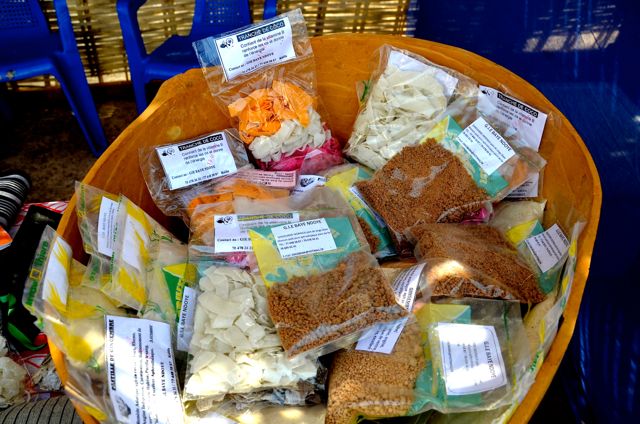
This year, an estimated 400+ members of the public attended the Fair over the course of the 3 days. 43 participating groups (over 140 individuals total) had stands in the Fair, displaying their products and offering demonstrations. Products and technologies on display included: solar pumps, moringa powder, packets of dried mangos (yum), mango jam, moringa soap, fonio (a kind of grain), beans, rice, shea butter (known as “karite” here), curd (called “kossam” – sour milk frozen into a yogurt-like treat), hibiscus (“bissap”) juice and tea leaves, fruits and vegetables, beautifully embroidered clothing, batik, artwork, herbs, baobab fruit powder, cashews, tomato paste, juices and syrups, cheese, and more.

Packets of local herbs
Batik clothing. I love the elephants!

Astou Mballo, tailor (Endam Couture), and her beautiful clothes!
Local produce
Ma Baldé and her women's group selling honey!

Baobab fruit, bissap (hibiscus), and more ground into powder form. Just add water, and presto: you have tea/juice!

Solar water pump
Locally made jams. Banana, Papaya, Mango... yum. 

I had to run around like a madwoman most of the time making sure everything was going smoothly, but when I had some time to browse the stands, I found some exciting stuff. In particular, I fell under the spell of everything mango – mango jam, dried mango. Kolda produces so many mangos each season, but so many of them go to waste due to poor transportation and export systems. You find yourself craving them months before they’re ripe, especially in this heat. Now I could taste mango before the season even arrived! Score.

Fair co-coordinator Mountaga Baldé with a bag of dried mangos 
Me with Mountaga, trying to get things organized!

Another reason to be happy: we had expanded the Fair this year beyond agriculture and into health (I am a Health PCV after all!) and the arts (throwing a youth talent show). In the health domain, we had free HIV testing and booths / discussions on family planning.

The booth raising awareness on Family Planning

The talent show was held in three parts each night of the Fair, with four middle school groups and one youth association competing. We had a dance competition the first night, theatre the second night, and singing/rap/poetry on the last night (slightly a smorgasbord of categories, I realize). Watching these kids do their thing was both hilarious and inspiring (depending on the performance!). Over 80 youth total competed, with more than 200 people attending the performances. During the theatre night, the kids actually performed skits on family planning and early marriage – with no prodding from me! I was surprised, but proud of them for their initiative.

Theatre competition
Theatre - a sketch on early marriage and how young girls refuse to let this be their future!
Dance competition - boys team doing breakdance
Dance competition - girls doing traditional style. It was great! (this team won)

Double Horizon members (local youth association) who competed in the talent show
PCVs at the judging panel!
Theatre sketch (on Family Planning). Yes, they painted white beards onto their faces. Love it!

Singing/rap competition

While a huge undertaking for one PCV to take on (in the past it has been a team of 4 or 5 PCVs), one of the Fair’s successes, in my opinion, is that we’ve begun to pass over ownership of the Fair to the community. Each year the initiative has relied heavily on PCVs to fund the project and provide much of the leadership. This year, there were no other PCVs available to lead the project except me. (Ahh!) However, since the community members really valued this initiative and wanted it to continue, I agreed to help make it happen.

As my caveat, though, I chopped the bloated Peace Corps grant budget in half from what it was in previous years and insisted that the community members find other sources of funding... and they did!

The burglary that occurred (when my house was broken into and 300,000 CFA - about $600 - worth of this grant was stolen) was a big problem for the project, and as a result we had to shift around a lot of the expenses in the budget. However, with local organizations (PADEC and World Vision) stepping up to become partners in the Fair, we were able to meet all the expenses of the original budget. This means much more of the responsibility went into local hands, and we are now in a transition period into handing over the Fair into local ownership.

In addition, the Senegalese members of the Fair organizational team each took on extreme amounts of work to make this event happen, because they really believed in it. Mountaga Baldé, one of our coordinators, took up a post at the Conseil Regional and was there all day, every day for two weeks leading up to the Fair in order to oversee construction of the stands and register participants. This was all without being paid. Basically, he put in over 80 hours of office time for free!

The other members as well went out of their way to bike all over town, following up with partners and participants, making purchases, printing documents, promoting the fair (radio, fliers, posters, and word of mouth), and getting as many people involved as possible. Just think... if this event were happening in the States, all we'd have to do is post it on Facebook, make some calls and emails, and half the publicity work would be done! What a different world.

Fair organizational partner Tidiane Diallo in front of his NGO's stands (PADEC) 

I'm really excited that the Fair has become a continuing Kolda tradition and source of pride for the community. Strolling around visiting people’s stands and asking about their work, it became clear to me that each individual vendor really believed in their products and in the potential of the Kolda region. From the vendors to the sponsors to the talent show contestants, the Fair highlighted to me just how much the people of Kolda – both young and old – really care about their future.


Traditional music

Advice for PCVs planning a Fair like this:

1.  Plan ahead (start 6 months in advance – we did this and it was just enough time), and don’t cram most of the activity into the month before the Fair (we also did this, by necessity, but avoid it if you can).

2.  Get local organizations involved (especially as sponsors). We couldn’t have accomplished the Fair this year without local sponsors!

3.  Organizations who offer to contribute financially should make their decision and sign a contract much further in advance. We were waiting until only weeks before the event to hear back from people!

4.  Add a contingency of minimum 10% of the total budget for a project of this size and scope, to cover all the last-minute expenses.

5.  Be wary of cutting out expenses just because you think they’re silly – often they’ll end up being thrown in at the last minute anyway. (For example, “motivations” to public officials to come and grace the Fair with their presence. I did not budget for what I viewed as a bribe, but other team members ended up paying it anyway, because that’s just how things are done here. If you want officials to show up at your event, you have to pay them.)

6.  Start more than 1 month in advance if you plan to have a talent show, to give the teams time to practice so nobody panics. Have something to give every participant in the talent show, not just the winners (they will be disappointed otherwise).

7.  It’s better to hold an activity like this in the center of town to attract more visitors. People don’t like going out of their way, even if it’s just a 15 minute walk.

8.  The Fair Organizational Team should consist of more than 4 people taking on most of the work. 6-7 people sharing responsibilities would be preferable.

9.  Maintain a running list of participants in all parts of the Fair (service providers, CBOs and individual vendors, organizations, financial institutions) with their contact information.

10.  Keep paperwork and records of everything!

11.  Laugh at anything and everything to keep your spirits up and keep the planning team on friendly terms. Don’t worry about appearing crazy – if you’re taking this on, you already are! (In the best way.)
PCV friends who showed up to check out the Fair... and have some kossam!

Wednesday, February 26, 2014

Video of Senegal Life: Dance Til You Drop!

Check out my YouTube video of Peace Corps life in Senegal so far! (Note: Watch full screen in HD for best effect - select the gear icon at the bottom of the movie, change to 720p.) 

One overarching thing I can say about Senegalese culture is this: the vibrancy of this West African country shines through most clearly in their love of dance. I will always admire the way Senegalese people can let loose their inhibitions and move with (or without) the music, always fluid and in rhythm, whenever and wherever the mood strikes them!


Note: This video was submitted for consideration in the Peace Corps Week 2014 (#PCWeek2014) Video Challenge, "Cultural Windows: What I wish Americans knew about my Peace Corps country." This contest encourages currently serving and returned Peace Corps Volunteers to help Americans better understand their country of service through engaging videos. This video does not reflect the official views of the Peace Corps or U.S. Government.

Sunday, January 19, 2014

The Break-In

A few nights ago, a thief broke into my hut. While I lay there sleeping, he scaled the back wall and dropped into my outdoor toilet area, cut a slit through the screen door to open the latch, and crept inside. He lifted up my mosquito net and grabbed my purse and camera from next to me, and then a bag of jewelry on his way out - all without me waking, somehow.

When I woke up, groggy because I hadn’t been able to fall asleep until around 3 or 4 AM, I reached for my purse and frowned when my hand touched nothing. Did I knock it on the floor? I sat up and scanned around me, confused when the bag was nowhere in sight. When I stood up to check the floor, I suddenly noticed the screen door standing wide open. My heart started pounding. Once I realized that the bag was genuinely gone - containing a big chunk of grant money I had just withdrawn for a project, my phone, camera, passport, checkbook, keys, bank cards, notebooks, and God knows what else - panic rose up, choking me.

I raced out of my room and told my host family, then ran around back, where it was confirmed: a big tire was propped up against the wall. That’s when the tears flooded out.

That day I was a mess, crying and furious and scared. Not just at the loss of all that money and all those things, but also because my little sanctuary in this tough country wasn’t a sanctuary any more. It wasn’t safe. Here was a person - or people - who had specifically sought me out and targeted me for a crime. Despite all that I had been doing to help the community, all they saw was my stupid white skin, like a giant bull’s eye.

My first coherent thought was: screw this. I’ve gone through enough, and I can’t take any more. I’m done with Senegal. I would pack my bags and take off. I had to get to the Peace Corps house to get help, because I didn’t even have a phone any more.

“I can’t stay here,” I told my host mom, throwing things into my backpack and still crying. “I’m leaving. Every day I have to deal with people mocking me, pointing at the ‘toubab’ and bothering me, and now this? Why should I try to live here and help people who can treat me like this?”

“Aïssatou, wait… these people, they know nothing,” Mariama (host mom) said, upset. “It’s dangerous here. You didn’t close and lock the back door? We told you to keep it closed, we told you to lock it…”

I love Mariama, but I didn’t want to listen to that. Nights could be sweltering in my hut. All I wanted was a little breeze. My back door opened into an enclosed area with stone walls higher than our heads. With all that, they expected me to close the metal door and bake myself each night in my little oven?

Seeing that slice through the screen door where the intruder cut through to open the latch made me feel sick. I still think about the fact that there was some guy creeping in my room as I was sleeping, reaching over to grab my bag from next to me. What would have happened if I had woken up? It terrifies me.

I hate being afraid. I’m proud of being that girl who goes off to Africa and travels solo to explore new places, cultures, and people. I like being independent and I like that I can do just fine on my own. Usually.

After the burglary, I spent the day alternately repeating my story (to family, police, Peace Corps, friends, etc.), crying, and filling out paperwork. It felt like a pile of stones was sitting on my chest.

But listening to my family asking if I wanted to come home, something inside me cringed. I am just starting to really accomplish things here… so many projects in the works. The Kolda agricultural Fair, my English clubs, youth camp, my work with talibé boys, my upcoming moringa causeries with women’s groups. I’m not a quitter.

So a few days have passed, and I’m still here. I’ve been running around visiting the bank and the police and chasing dead ends. I’ve told and retold the story, and each time the heaviness of it has eased up bit by bit.

Finally, a day came when I felt oddly energized and at peace. It was completely unexpected… but wonderful. I couldn’t explain why I felt that way, but happiness was making a reappearance. The sky seemed clearer, the air was crisper on my skin, and smiles kept surfacing.

It was strange feeling so happy after the incident, but I guess the break-in has made me appreciate everything I still have left, including good friends and my own life - thankfully the guy never touched me! And no one I love was hurt. What are things in comparison to that? Not to mention the guy managed not to steal the two electronics most important to me: my computer and iPod, which were both lying next to me on the bed. I can’t explain that, but I feel blessed. (Although not having my little camera still sucks. Such is life.)

Biking around Kolda the other day, for the first time, I felt absolutely nothing and no irritation when kids yelled “toubahaako” at me (a cheeky little insult / play on the word “toubab”). Usually it grates on me, but this time it all rolled off my back like raindrops on a raincoat. I blew them a kiss.

Before the Christmas holidays, everything had been great for me in Senegal. But after returning from an amazing vacation in Australia, I found myself feeling a bit down at the re-immersion into the grit and hardship of Peace Corps life. I was noticing all the dirt, the noise, the smells; I was missing my invisibility and independence; I was missing art and culture and food variety – and just variety in general. I was finding the Senegalese men abrasive. I tried to orient myself and keep optimistic, but my heart wasn’t aligning with my head.

Then the burglary happened. And now all of those negative thoughts have basically… dissipated. I’m not looking at the dirt, but focusing on the sunsets, the brilliant African fabrics, the trees, and the big smiles of my friends. I’m laughing at the funny aspects of life here (telling any Diallo I meet that he’s a bean-eater, goats balancing on the weirdest ledges imaginable, sheep getting in the way everywhere) and the random adventures (meeting a magic man, seeing a radio technician at work, watching workers use a rope and pulley to build an elaborate mosque tower by hand). Community members and Senegalese friends have been so supportive. A beautiful new baby just arrived in my host family. Life is never boring, I can say that.

As crazy as it may sound, I feel like the break-in was the storm that cleared out my murky skies, leaving me with only blue.

Host family's new baby boy.


Saturday, January 11, 2014

Mini Christmas in a Muslim Country

Ever get a little tired of the same old Christmas shenanigans (shopping fever, Santa suits, onslaughts of “Christmas albums”, etc.)? Try spending the holidays in a Muslim country.

In Senegal, with over 90% of its population of 13 million practicing Islam, I definitely did not expect much attention to be paid to Christmas. After living in Senegal for nine months, joining my host family in their celebrations of traditional Islamic holidays (Ramadan, Korité, Tabaski – which mostly involved dressing up and eating way too much goat/sheep), I thought maybe we’d all wish each other a few “Joyeux Noëls” and that would be that.

However, I was pleasantly surprised to find a cheerful embracing of Christmas in Senegal – celebrated unofficially, of course. But a stroll around the capital city of Dakar during the holidays turned up tinsel decorations, Christmas trees, and street hawkers selling inflatable Santas… even while calls to prayer echoed from the mosques.

Market-Lover's Paradise

Wandering the streets of Dakar in mid-December, I stumbled onto one of the city’s holiday surprises: the “Marché de Noël” (Christmas Market), hidden behind the walls of the Institut Français. As I entered, shaking off the persistent vendor who had glued himself to my side (finally!), I wasn’t sure what to expect. Shopping in Senegal usually requires a strong dose of patience, since you have to bargain for almost everything.

As it turned out, the Marché de Noël proved to be a tranquil haven from the usual bustle of Dakar. Inside the walls, the gardens rippled with greenery and soft music. Light dappled its way through the trees to the pebbled paths, where dozens of artisans and vendors had set up shop. Local artists mixed with expats to offer fair trade prices, promoting creative products you might never encounter just by roaming Dakar’s usual boutiques and markets.

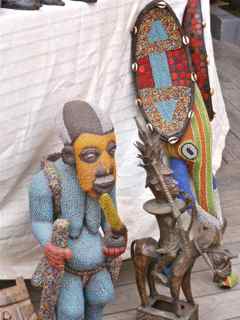
Everywhere I turned, I saw up blazes of color. Rows of beaded jewelry lay next to hand-woven scarves, painted earrings, CDs of African music, sculptures carved from wood or made from recycled materials, shoes and stuffed elephants sewn from brightly patterned Senegalese fabrics, organic foods promoting local products, and more.


To start, I wandered through the tables of beaded, metal, and painted wooden jewelry. Some were simple silver pendants in tribal patterns; others were thick ropes of colorful beads. There were displays of woven cotton scarves, racks of breezy dresses and stylish clothing made from brightly patterned African fabrics, and other tables of purses, wallets, and knickknacks.

Each time I stopped to ask, the vendors were happy to tell me their story: a Senegalese women’s group finding new markets for their crafts, small but growing family businesses, expat artists who discovered inspiration in Senegal and decided to stay.

One young Senegalese woman named Aïssatou Sene had started her own fashion line, Bélya, making shoes and blazers from local fabrics. “I’m saving up to open my own shop soon,” she told me happily.


At another table, the group Empire des Enfants sold leather and beaded keychains made by former street kids – boys trying to learn a trade and create a new life for themselves.

Nearby, a French expat displayed purses and earrings she’d made out of cut-up and painted vinyl records. Another French artist, known as Fallou, collected fallen calebasse fruit and carved the gourds into bowls, candle holders, and ink-dyed earrings. “You can find it in the streets of Dakar!” he said, grinning.


Seductive Liqueurs

As I continued wandering, a table of bottles caught my eye. Topped in flourishes of fabric, the bottles glowed with golden liquid in the sun. Bending over to examine the labels, I was intrigued to discover that La Marquise was a “boisson alcoolisée” – a liqueur mixing rum from Cape Verde with South African white wine, spices from Madagascar, and Senegalese fruit. Flavors included mango, ginger, orange, tamarind, mad (a sour West African fruit), pineapple, passion fruit, and lemon. Pieces of fruit lined the bottoms of the bottles.

Noting my interest, the lady seated regally behind her creations offered me a sample, and I accepted a small test cup of passion fruit Marquise. Gearing up for the alcoholic jolt, I was shocked when the liqueur slid smoothly down (no cringe moment!) in a tangle of fruit and spices. The taste of rum was faint but just present enough to add a slight kick. Not bad for 7,000 CFA (less than $15) per bottle.

“I love the fabric at the top of the bottles,” I told the vendors.

“They’re like the head pieces that the Pulaar women wear, aren’t they?” one responded, smiling. I hadn’t thought of that, but the swirl of fabric did recall the local tikas worn by many women in my town of Kolda, in south Senegal.


According to the vendors, the Marquise liqueur recipe was passed down from their grandmothers and great-grandmothers since pre-colonial times. “La Marquise remains just as exhilarating and naughty today, especially in ginger,” noted the informational flier in flowery French. (Yes, I had to suppress giggles while reading this. Note: a gift of fresh ginger is considered quite seductive Senegal.)

The producers of Marquise don’t have a shop of their own yet – but in typical Senegalese fashion, you can give the vendor a call and she’ll make arrangements for you, no problemo. (Les Ateliers Nylanou, +221 338222718).

For the Food Lovers

The logical next step after the liqueur tasting was to visit the cheerful Michèle Jouga of Les Nougatines de Mame Michèle (+221 338231777). She sold peanut brittle, nougat, and organic jams in flavors of bissap (hibiscus)-menthe, orange-papaya, lemon, and baobab fruit (known as “pain du singe” – monkey bread). Samples provided.

Across the path, young Khady Ba showed off the products her family business: Milmaïs Bakery (+221 766808528), an enterprise using local products to make organic breads low in sugar, fat, and salt.

“My father Assane Ba founded the company,” Khady Ba told me proudly. “We don’t have a shop yet, which is why we offer free deliveries, but we hope to expand soon.”

The breads, sold in soft oval-shaped loaves, came in blends of maize, peanut, millet, fonio, sorghum, and even moringa (a highly nutritious plant many health workers – including myself! – are trying to promote throughout Senegal). I bought a moringa loaf, loving the sourdough-like taste. Wish I could bring that down south to Kolda...


Unlike most markets in Senegal, Marché Noël sold items at fixed prices - but some vendors offered slight discounts if I was chatty enough. In any case, the benefits brought to the local community were obvious, and I was happy to spend a little extra. Senegal’s Christmas may not be as flashy as the Western version, but think what they’re promoting: peaceful coexistence between religions, plus (through this market) support for local artists and entrepreneurs. In my book, that’s even better!


Saturday, November 9, 2013

Senegal’s Child Beggars

I believe in facing your fears.  As it turns out, my biggest challenge and personal fear in Senegal comes in a very small package: talibé, the children begging in the streets of Senegal's towns and cities.

Thrusting their skinny hands in your face through the windows of cars, surrounding you in a mob of shrill voices shouting “toubab” and demanding money, or just tiredly muttering Quranic verses as they hold out their yellow bowls, these (often barefoot) children in tattered clothes flood the streets of nearly every major city in Senegal.

As soon as they notice me and my white skin, which they equate with money, the kids rush over and glue themselves to my side like barnacles.  Ever since my first week in Senegal, they have by turns made me sad (who could do this to little kids?), driven me crazy with irritation (stop following me, just leave me alone), sparked me to anger (they need to get out of my face), made me nervous (am I going to look stupid if I don’t have a good Pulaar response?), and – a rising tide under it all – stirred deep feelings of guilt.

Why guilt?  Because my first exposures to them, during my first few months in Senegal, elicited an instinctively adverse reaction.  I didn’t know how to handle these kids, so they became my nightmare.  If I saw a pack of them, I tried to avoid the group.  They were caked in dust and dirt, staring at me out of infected eyes, heads sometimes covered in sores.  Overwhelming, because I didn’t know what I could possibly do.  There are so many. 

So I unconsciously started doing what many Senegalese do: tossing them a few smiles (or coins) and going about my day, forgetting.  Eventually, talibé become a predictable daily occurrence, almost like potholes in a road well traveled: you know they’re going to be there, you know you have to avoid them or navigate the bump, so you get it over with quickly and move on. 

Many people here don’t give talibé a second thought, except to dismiss them as obligations (for the giving of alms) or irritations.  One documentary film has labeled them “the least favored children of Senegal.”

There are an estimated half a million talibé in Senegal. Approximately 50,000 of those children are sent out begging or "subjected to conditions akin to slavery," according to Human Rights Watch.

Students Who Beg

The strange reality is: these kids are actually students.  In Senegal, children as young as five years old can be sent off by their families to become talibé, living and studying for as many as 11 years under a Quranic teacher (marabout) at his school (daara), often in conditions of extreme poverty. 

Talibé spend their days memorizing the Quran and begging for alms in the streets.  In many cases, they receive no meals from the marabout, so they must go out begging up to three times a day if they want to eat.

Talibé studying the Quran

A talibé entering his room

The ascetic nature of this type of education has traditionally been considered a way of teaching humility, as well as a rite of passage for boys into adulthood.  However, the system has become twisted in so many ways that it’s almost impossible to imagine how to begin untangling it.  Kids suffer and often their families never know. 

Unfortunately, poor families often see daaras as an escape – a way to lift the burden of financial support by sending their child away for a good cause.  (Parents have told me, “If we can’t pay for his public school fees anyway, why not send him to get a free education? Anyway, it’s good to learn the Quran.”)  Many talibé end up living in cities far from their original villages or towns, and sometimes families lose touch with their child for years.  A number of talibé in Senegal actually come from neighboring countries such as Mali, Guinea or Guinea-Bissau.

Human Rights Violations

Over the past few years in Senegal, reports have emerged of some marabouts exploiting talibé to grow rich off their earnings, while the boys lived in slavery-like conditions.  Many are forced to beg and punished if they fail to bring in their daily quota of food or money to their Marabout.  Several have reported being chained or beaten as punishment. 

In 2010, Human Rights Watch reported on the physical and sexual abuse some talibé experience, and seven Marabouts were arrested that year.  Anti-Slavery International wrote another report in 2011 highlighting the hardships these boys face and urging the Senegalese government to protect these children’s rights. 

Legislation banning “forced child begging” was actually passed in 2005.  But the tradition of Quranic education runs deep in Senegal, and the influence of marabouts and Islamic leaders stretches far.  In the end, they found a loophole for the talibé system: “soliciting alms” is not “begging,” they said. And so it continues.

(Please note that not all marabouts perpetuate harmful practices; many do care about their students and treat them well, but are simply stuck in poverty.)

Check out this video by Human Rights Watch for more info on the daara system:
https://www.youtube.com/watch?time_continue=2&v=qIigeLgtves.

Talibé In My Town

For me, after moving to my permanent site (Kolda, a regional capital in south Senegal), the talibé issue suddenly became personal and immediate.  My service here in Senegal has been all about helping wherever I can, finding those small cracks I can fill, facing my fears and trying to overcome my flaws.  I realized that I might be uncomfortable with talibé (and the whole daara system itself), but that was no reason to push the issue aside.  There are enough people doing that.

So I chose to confront my discomfort. 

Since I was placed in a small city and not in a village, I interact with talibé every single day.  They seem to appear around every street corner!  After my first month living in Kolda, I started forcing myself to stop and talk to the talibé, even with my limited Pulaar.  Giving out money is a tricky issue, since you’re also perpetuating the system in a way (this article - "Keep the Change" - argues against giving).  But once in a while, just to make a kid happy, I’ll give some extra food or a piece of candy.  They have so few bright spots in their days.  And they really do walk around barefoot, on dirty streets sprinkled with animal manure and broken glass (to name a few things).

Eventually, I started visiting daaras in Kolda with a Senegalese counterpart, introducing myself to the marabouts (which is still pretty intimidating) and researching how many talibé studied or lived there, the health conditions, their sleeping situations, etc.  So far, I have visited 18 daaras – and there are many left to visit.  Even the official local Inspector in charge of daaras and Arabic schools didn’t know how many existed in Kolda, and he’d never heard of several that I’d visited. 

The conditions I’ve witnessed are pretty dismal: bare rooms where boys sleep on the concrete floor, maybe on a mat if they’re lucky.  Usually there are not enough mosquito nets for all the children, making them highly susceptible to malaria.  The boys wear the same clothes every day.  With a few exceptions, most daaras here in Kolda teach the boys only the Quran and nothing else – so they never learn how to read and write, and never learn French (unlike their peers in public schools).  This severely limits their opportunities for the future. 

Marabout showing me where the talibés sleep

Talibé asleep in the room he shares with many other boys

Marabout laughing with his kids

Older talibés in their room

Group of talibés showing me their room

My Projects

Since no recent Peace Corps volunteer in Kolda that I know of has yet worked with talibé, I’ve decided to tackle what was originally a fear of mine and make talibé my primary focus for projects over the next two years.  After all, who cares if it makes me uncomfortable?  Here is a need, and I can address it, at least in some small ways.  So I’m going to try.

Recently I was elected to the board of SeneGAD, our Gender and Development group in PC Senegal, as Talibé Coordinator – so there’s my start.  In addition to my personal projects, I will also be acting as a resource for other PCVs interested in working with talibé. 

Here are some of the projects I plan to do in Kolda:

  • Verify that they get enough mosquito nets during the upcoming national distribution 
  • Health talks (causeries) on nutrition, malaria, hygiene and hand washing, diseases, etc.
  • “Men As Partners” event, which sends a male Senegalese representative from Peace Corps to talk to the boys about their future, sex ed and reproductive health, violence, etc.
  • Conference / event to advocate daara "modernization," as it is referred to in Senegal (improving conditions in daaras; teaching talibé a trade or sending them to French school, in addition to their Quranic studies) 
  • French / alphabetization / literacy lessons with the kids

With the daara system so deeply entrenched in Senegalese society, I don’t know how long it will take for things to change in Senegal.  But I do know that I can try to help these boys that live in Kolda, even if it’s just to expand horizons a little or improve their health on a basic level.  I can try to help Habibu, that smart little talibé that hangs out downtown and knows me by name. 

After all, these are human beings we’re talking about.  Senegal’s future.  What’s more important than that?  So stay tuned for future stories!  In the mean time…

PLEASE DONATE:

If you’re interested in helping me reach out to the talibé, please support the work I’m doing by clicking on the “DONATE” PayPal button at the top of this website.  I am collecting donations to purchase these simple items for my health causeries:

  • Bars of soap (25-50¢ per bar, depending on size) – Just $10 can buy 20-40 bars, enough for 1 daara! 
  • Hand washing stations – bucket and pouring kettle ($4-6)
  • Powder laundry soap (“Omo” – 10-50¢ per packet, depending on size)
  • Bleach (“Eau de Javel” – $1 per bottle)

At this time, I only plan to distribute a few simple hygienic items to each daara, to go along with my health lessons.  This way I can help talibs practice what I teach, but will avoid creating dependency through large gifts.

DAARA DRIVE:

If you would like to support my work with talibé by donating items yourself, feel free to mail things like secondhand clothing, shoes (flip flops are great), light blankets or sheets, balls, marbles, simple games like checkers, etc.!  I am starting this drive now, but will not be distributing items until later in my service.  The idea is to establish a good relationship with the daaras first, conducting educational activities and events, so that handouts aren’t expected.  Ultimately, I will distribute the items to the daaras that I have formed the best relationships with. 

Mail items to:
PCV Lauren Seibert
Corps de la Paix
B.P. 26
Kolda, Senegal


Tuesday, October 29, 2013

Quote of the Day - Senegal Love

_______________________________________
Me: "Would you ever want to live anywhere else besides Senegal? Another country?"
Madou: "To visit, yes, but not to live forever."
Me: "Why?"
Madou: "Anywhere else I go, I would be a stranger. Here I'm home. I love Senegal. It is very poor, yes, but there is a strong sense of community. We care about each other, we just want to help everyone... that's why sometimes we stretch ourselves too far! But it's a good country." 
_______________________________________


Sunday, October 6, 2013

Surprise, You're In Charge

Add three Peace Corps Volunteers to a mix of 52 Senegalese teenagers, three local English teachers, a dusty school building, heaps of sand and sun, and unrestricted creative potential, and what do you get?

A pretty unorthodox but successful (and fun) English camp in Dakar.

I’m still wondering how we pulled it off, considering I had never done an English camp before and the entire week was full of last-minute discoveries - such as: you’re in charge of planning and leading the entire camp! (We thought we would be assistants.) You’re on your own for printing any documents you need... and probably no one will help you! (You’d be amazed at the difficulty of cheaply and easily printing things in Senegal.) Naturally, you wait until just before camp starts each morning to buy any supplies needed – just send off one of the English teachers!

My closest PCV friend Faith and I fell into the leadership roles for this camp, so we both stepped up and alternated taking charge. Each night before the next day of camp, we brainstormed activity ideas and planned out the schedule, trying to make it as fun as possible for the teens.

The kids ranged from age 14 to 17, with English levels all over the spectrum. Some could barely form a sentence, while others could express their ideas and hold discussions. Some were shy, some were eager, some were cheeky. We had to come up with activities and games that would engage all of these levels.

In the end, it wasn’t too hard to think of ideas: we had already gone through the reverse cultural immersion ourselves, as new American volunteers getting used to Senegal and learning a new language. So we could put ourselves in their shoes. We figured they would want more talking and interaction games rather than writing. We guessed they’d want to get in the know on American pop culture, colloquial lingo, and how young people live in the States. We also figured they’d want to dance (Senegalese love to dance). Plenty music, check.

On the first day, we did a bunch of icebreakers and gave them each an American name, which was pretty funny. We supplied the last names (ranging from Martinez to Li to Jones), and they chose the first names (hence a boy naming himself Beyoncé).

First was Cross Culture day, where we talked about our own experiences with cultural transition, then did a True/False contest (we were intrigued to discover they didn’t know that American men propose marriage with a diamond ring... so naturally we acted out the scene for them). Next we had them make funny skits about some of the differences between our cultures. One of my groups made a skit about an American girl fending off marriage proposals from her taxi driver, which was hilarious and really does happen all the time. Another group acted out a Senegalese guy trying to bargain for items in America. One kid, playing an American, even shouted out “Are you kidding me?!”


On Pop Culture day, we played all kinds of American music and taught them our crazy dances (everything from the Cupid Shuffle to the Wobble and the Dougie). It was hilarious watching them attempt these dances – some kids inevitably held back, but a bunch of them got really into it. They didn’t like the Cha Cha Slide, but they rocked the Dougie.


Unlike American teens of the same age, these kids weren’t sarcastic or too cool for camp. They were young, so occasionally they got rowdy… but they were interested in learning and willing to try most things. If an element of competition was involved, even better. We did a bunch of outdoor games too, from egg races to musical chairs with Michael Jackson songs.


Geography Day involved stressing the massive diversity and regional differences of the United States. I drew a big map of the States on the chalkboard, and we passed out pictures of things representing each major region of the U.S., and we had the different groups present. Obviously this was very subjective… so there now exists a group of kids in Senegal who know about random things like chicken and waffles, Philly cheesesteaks, and bubble tea. But hey… America is pretty random.


On the last day, we had a party – music, talent show, prizes, food and all. “Talents” performed ranged from a group of girls singing “My Heart Will Go On” (they picked this on their own, I kid you not) to guys rapping in English and two comedy skits.


In the end, though it took a lot of work, the camp was deemed a success. In evaluation surveys we collected, every participant said they enjoyed the camp and would do it again, and everyone felt like their English had improved. Some of their responses were really sweet: “This English camp helped me to know more things that I didn’t know. It made me to be very happy and to feel better too.” And: “I would like to do [camp] again, and not just for the next year, but for every year.”

The funniest response to the question “Would you do English Camp again next year?” was scribbled in all capitals: “YES YES YES YES.” This was my first time ever planning an English camp, but I’d do it again in a heartbeat – hopefully with more prep time! But most likely, we’ll still end up running around last minute trying buy bottles of bissap juice while calling the school principal to unlock the gate, and by the way, where are all the chairs? T.I.S. (This Is Senegal).

Me with my team